
Caring for Roses in Summer: 12 Tips to Keep Them Thriving in the Heat
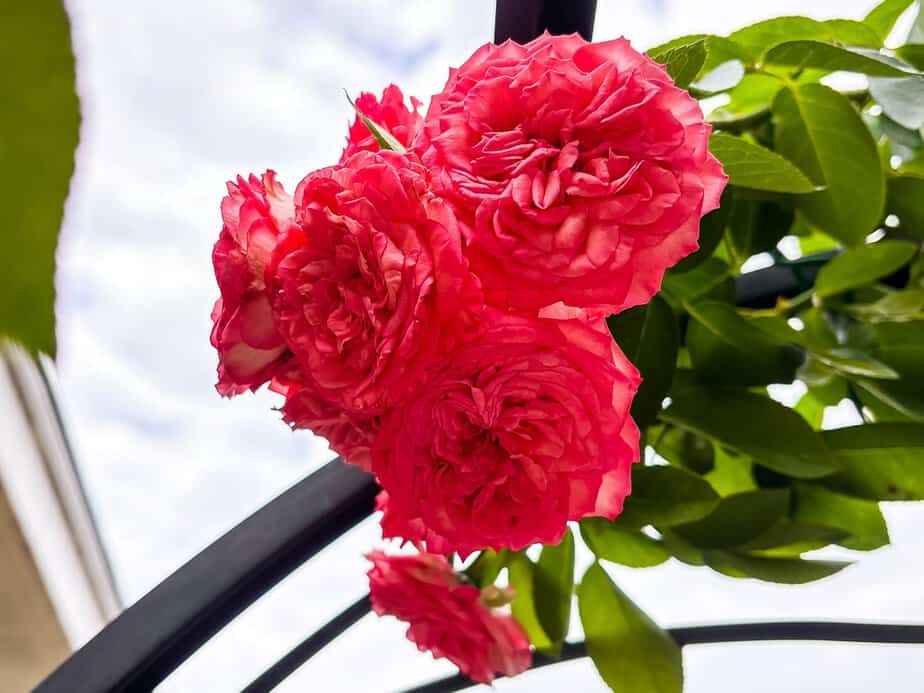
Caring for roses in summer doesn’t have to be hard! Get 12 simple, budget-friendly tips to keep your roses healthy & hydrated all season long.
If you live somewhere with scorching summers as I do here in Texas, you know that keeping roses alive once the temperatures climbs past 95 degrees can feel like a full-time job.
The good news? After years of trial and error (including a few roses I lost along the way!), I’ve learned exactly what it takes to help my rose garden not just survive, but thrive through the hottest months.
From watering schedules to homemade shade tents and my favorite summer fertilizers, these are the exact tips I use in my own garden to keep my roses happy when the heat index feels unbearable.
Whether you have 5 roses or 50, these simple, budget-friendly tricks will help you feel a lot more confident about your plants’ health this summer.
(As an Amazon affiliate I earn from qualifying purchases. Please see my full disclosure HERE).
Caring for Roses in Summer Heat
Tip #1: How Often to Water Roses in Summer
Roses do best when they are watered deeply, but infrequently. However, when you live in a hot climate, your roses will need to be watered more often to keep them hydrated. The trick is knowing exactly how much more.
Water your roses deeply when the soil 3 inches down is dry. Before watering again, check the soil 3 inches down. If it’s dry, go ahead and water, if it’s still moist, wait a day or two. The best time of the day to water is the morning.
Young roses will need to be watered more often.
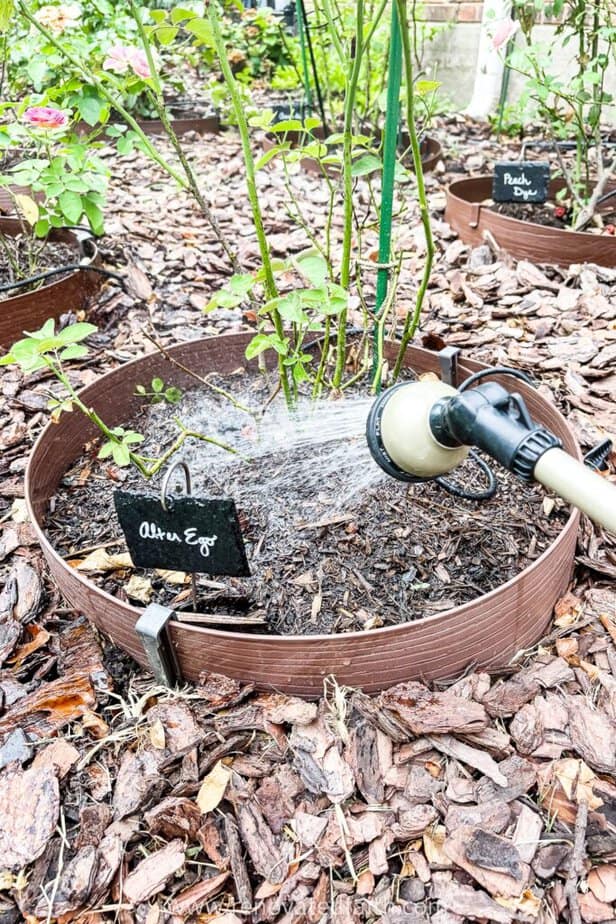
In Central Texas, our temps are already over 95 degrees and we aren’t getting much, if any, rain. So, I run my drip system for 15-20 minutes every 3 days.
Did you know you can actually overwater your roses in summer? Last summer I had surgery and set my drip timer to water deeply every single day. Before I knew it, I had waterlogged roses and a few didn’t recover.
Tip 2: Drip Irrigation
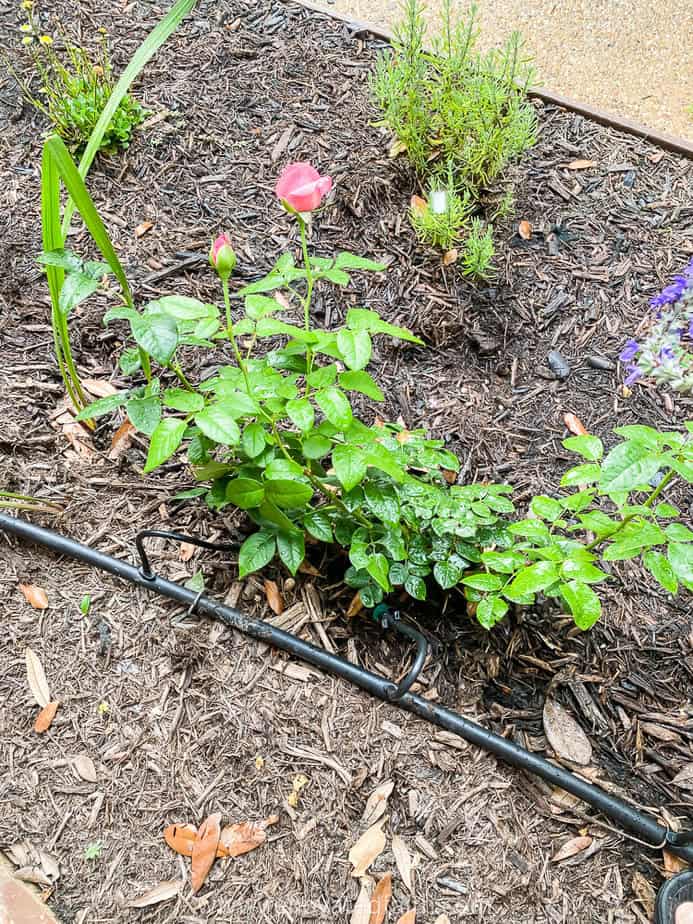
Drip irrigation has been such a Godsend, as it delivers water right to the base of the plant at the rate and frequency I choose. I even have my drip irrigation on a timer. You can see my easy beginner tutorials here:
How to Set Up Drip Irrigation for Roses and Landscape Plants | How to Set up Drip Irrigation for Pot Plants
Tip 3: Rose Rings
I put rings of plastic edging around my roses so that all the water and nutrients stays in place at the base of the rose. The idea is that the rings protect nutrients and retain moisture to create a healthy soil biome around the base of the plant.
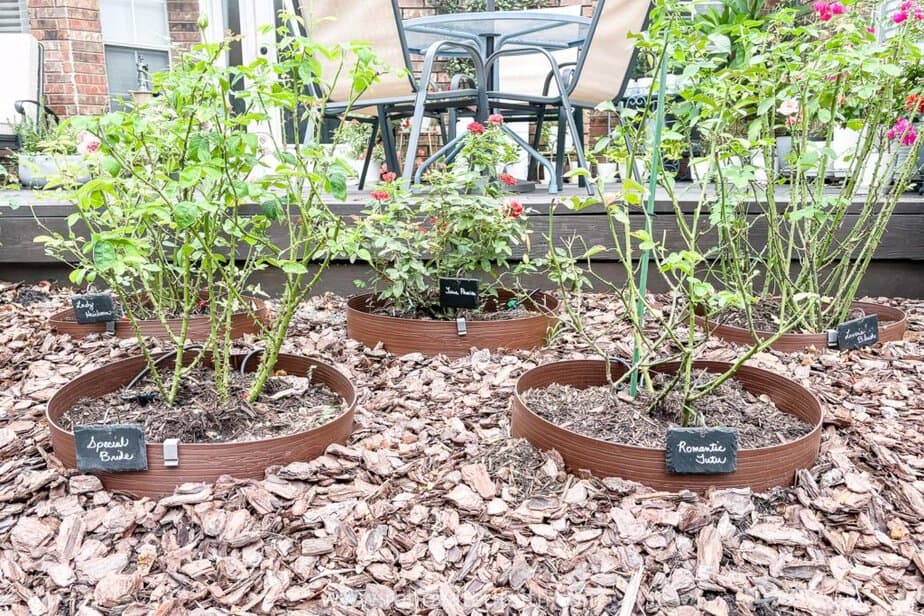
I noticed last summer that a lot of my water was running off of my raised beds. Also, I didn’t want my precious compost, and amendments getting washed away with it. So I thought about putting rings around my roses and stumbled upon this article of someone already using rose rings.
The rose rings have proved to help my roses all year round but especially in summer. Instead of any water running off, it is trapped by the ring and that water stays in place on the inside edge of the ring. (I realized this when I saw that weeds always try to grow on the inside edge.)
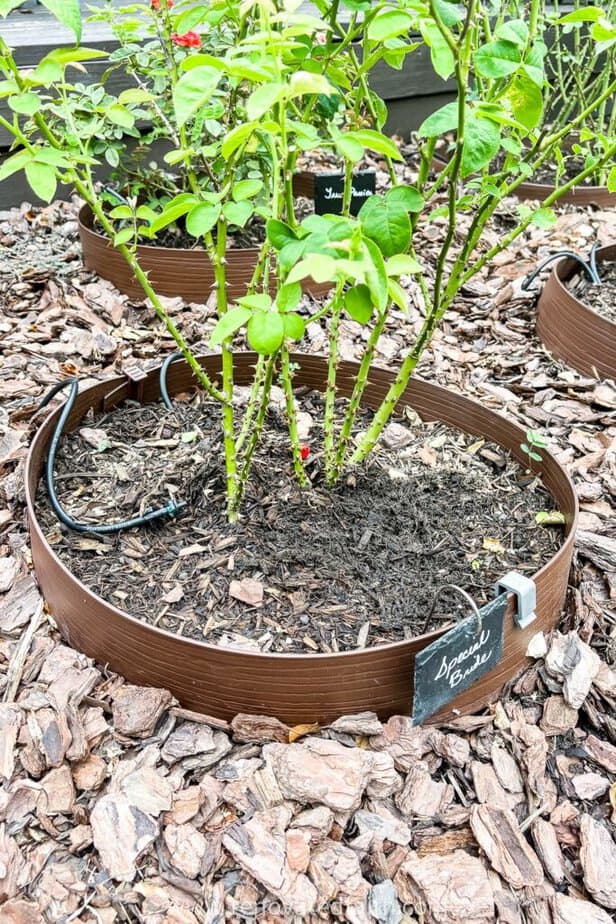
That’s ideal because it forces my roots to spread out more to get this water instead of staying consolidated right under the drip emitters.
The rings also help to keep my dogs out of the organic amendments and protect the roses as they run through them at full speed.
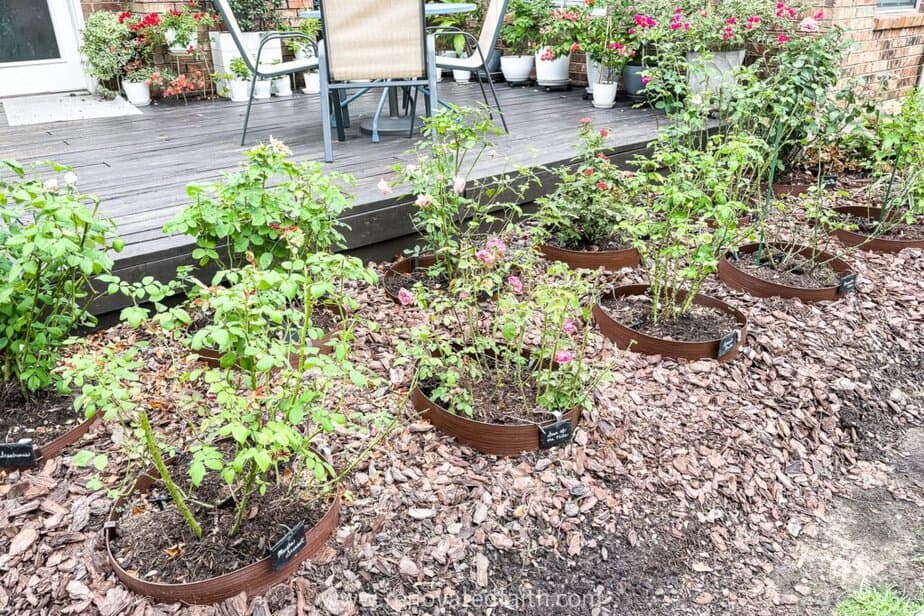
To make your own rose rings, get this plastic edging, cut it with a boxcutter and secure them around the roses with two of the pegs that come with the edging. I just push them into the ground about an inch or two deep.
Tip 4: Mulch Your Roses
Mulch benefits your roses in two important ways during the hot summer months. They retain precious water around the base of your roses and they prevent weeds.
Did you know that weeds soak up water and nutrients significantly faster than your roses? That’s because they have the ability to grow extensive root systems quickly.
I use either Happy Grow compost or cotton burr compost as my mulch inside the rings and I use pine nuggets outside the rings because they last much longer than shredded mulch.
Mulch is also important because this year’s mulch is next year’s compost, which improves your soil health.
Tip 5: Only Use Organic Fertilizer in the Summer
Should you feed your roses in summer? If you fertilize during the summer, go organic with fertilizers low in nitrogen (leaf growth) and phosphorus (blooming).
Synthetic fertilizers are fine during the spring or fall but they can stress plants in summer when they are already overwhelmed by the heat. We don’t want to force an already-stressed plant to produce new growth and blooms when ideally the plant needs to focus on root growth and maintenance in the summer months.
RELATED: Gale Hammond’s DIY Rose Fertilizer Mix (Add in Spring and Fall
What to Feed Roses in Summer
Organic fertilizers are great because they are gentle and feed the soil to promote soil health in the summer and long-term. Common examples of gentle organic fertilizers are alfalfa pellets, cracked corn (see the next tip), and fish emulsion.
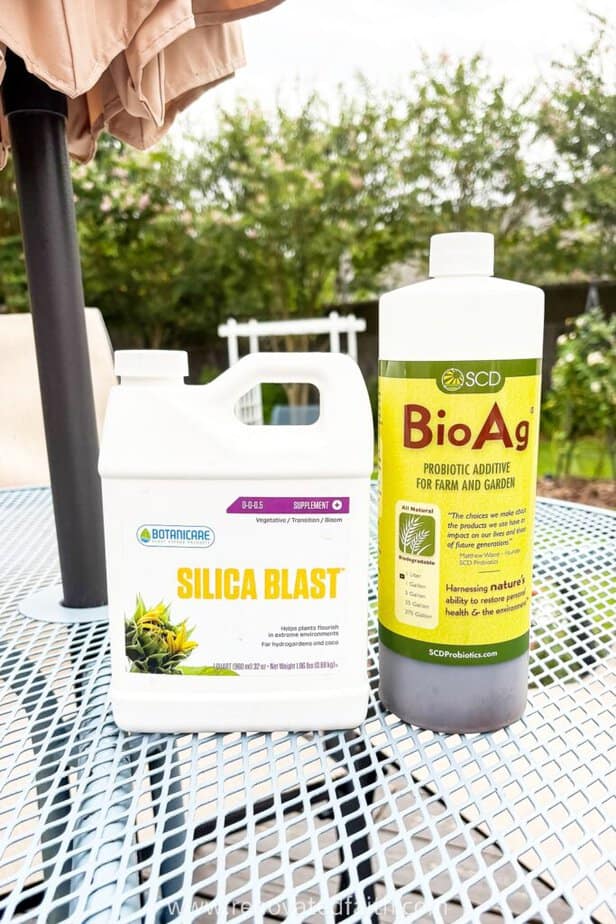
My Favorite Soil Additives for Summer and Year-Round
- BioAg Soil Revitalizer – This is a probiotic that balances your soil’s health and I get basal breaks every time I use it. I put it in this hose end sprayer at a rate of 1 tsp/gallon and spray the root zone.
- Slica Blast – This helps plants flourish in extreme environments by strengthening plant tissue. I use the same hose end sprayer above to apply it at a rate of 1/2 to 1 tsp/gallon.
How Often to Feed Roses in Summer
I like to put an organic amendment on my soil once a month during the the summer to give them a boost and also organic amendments buffer low or high ph.
Tip 6: Use Cracked Corn Around Roses
My tap water has a high pH, and roses get more tap water in summer than any other time. Over time, that tap water is going to drive up the pH. Roses need a pH of 6.0 to 6.9 with 6.5 being optimum. When the PH is too high or too low, it acts like a lock on a door, where roses can’t absorb soil nutrients that are already present in the soil.
My tap water is over 8.1. So how do I keep the ph down in summer months when my roses are bombarded with high-pH tap water? Cracked corn!
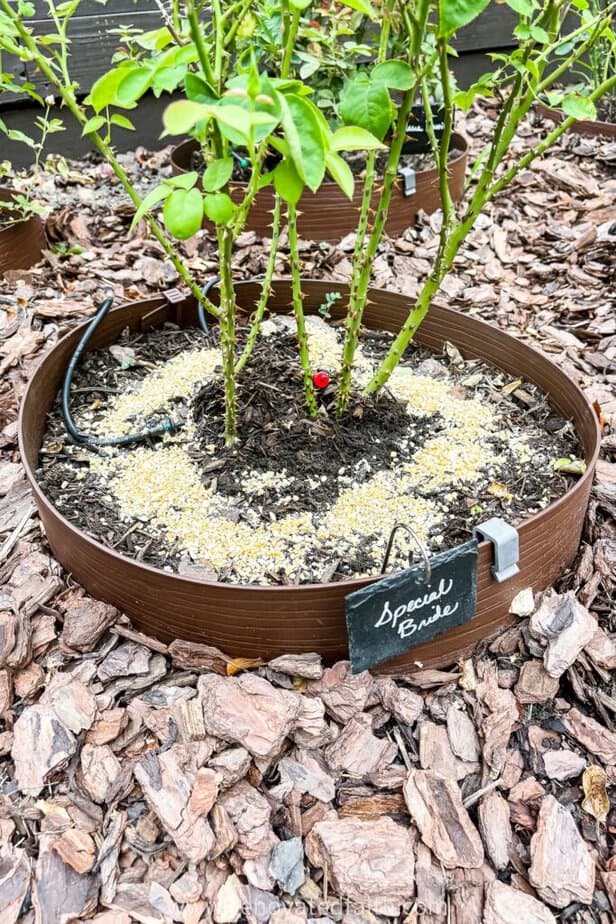
Every year, when most of the rain has stopped, I add 2 cups of cracked corn in a circle about 6 inches from the base of each rose. Then I cover it with Happy Grow compost to keep animals from eating it.
Cracked corn brings down the soil quite a bit. Once a tested some corn in water and let it sit a few days and the PH was 3.2.
Want to know your soil pH? You can test it with this: Digital Soil pH Tester
Cracked corn is also the cheapest source of instant potassium, which roses need during the hot summer months. You can get a huge 40-50 lb. bag at Walmart or Tractor Supply for $10-20.
Tip 7: Spray Your Roses With Water Regularly
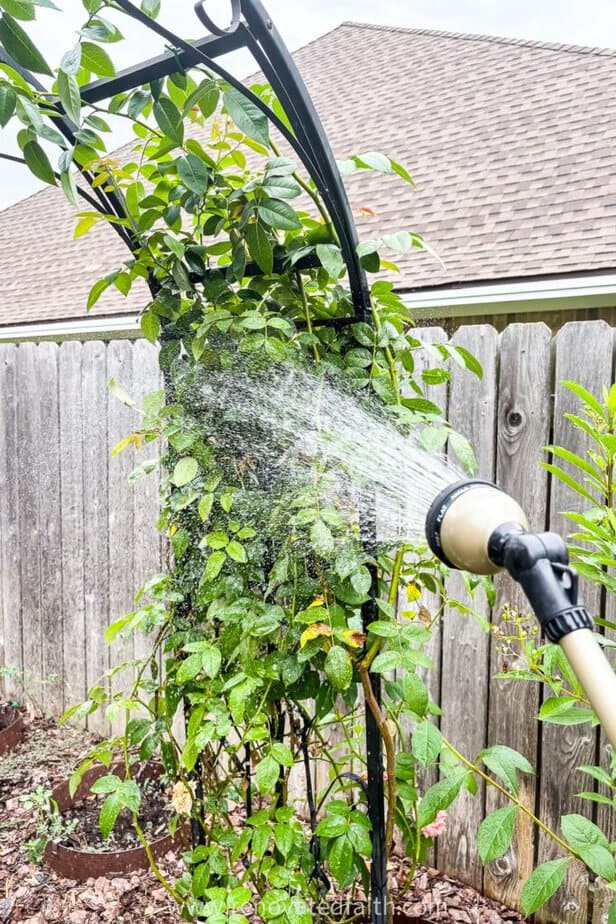
Use the nozzle on your hose to spray down the foliage and canes regularly to cool off your roses. I try to do this two to three times a week and always in the morning. Not only does this help to cool down roses, but it also deters chilli thrips* and spider mites, which love the dry, hot weather.
Many people say not to get water on your roses, but I’ve never had a problem with black spot after sprayingthe leaves. (I have heard that having high-pH tap water can actually deter blackspot if you spray it on leaves after rain.)
Here’s a LONG spray wand that I love using to get the tops and bottoms of plants: 36” Watering Wand
Chilli thrips thrive in hot weather. If you do have them, I highly recommend a product with Spinosad like Conserve SC or this lower priced option: Fertilome Spinosad
Tip 8: Should You Deadhead Roses in Summer? Yes and No.
Conventional wisdom says to stop deadheading when the heat is high and that is usually a safe bet. The idea is that when you trim a bloom, that cut encourages new growth and more blooms – which we don’t want in high heat.
With that said, in 2012 there was a major drought, and several Texas growers chopped their roses down really short because water evaporation occurs at the canes & leaves. For that reason, several nurseries are pruing off the leaves when they ship out roses today.
So here’s what I do:
How to Deadhead Roses in Summer
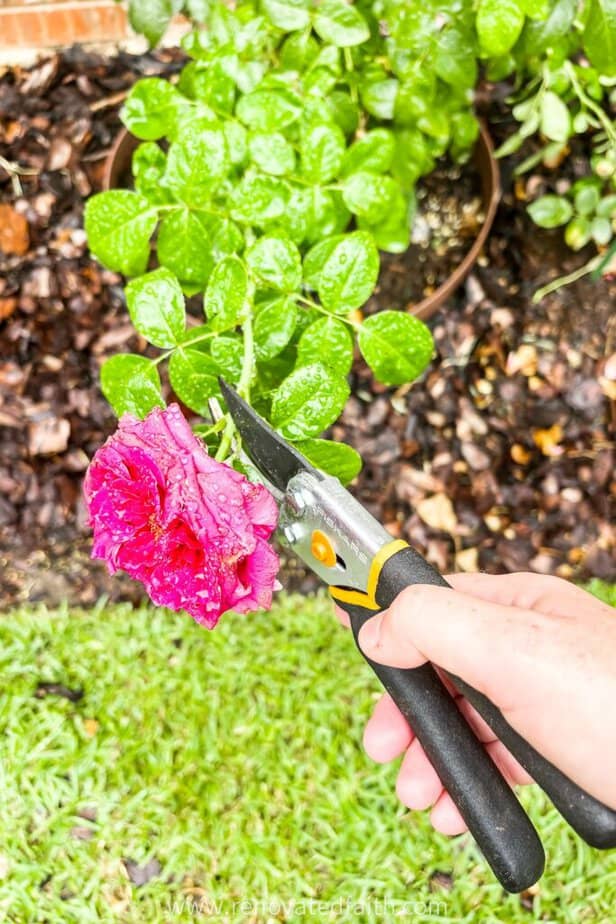
For heat-loving roses that are putting on lots of new growth in summer, like Sweet Mademoiselle or Dee-lish, I not only deadhead them, but I trim them down a foot when they get over 6 feet tall.
For most roses that seem to be healthy in that they are not losing leaves or have cane dieback, I go ahead and deadhead them through the summer.
For young roses that are struggling or less heat-tolerant roses, I will stop deadheading.
For roses that I’m afraid of losing because they are really struggling, I will pinch off all buds so the plant’s energy doesn’t go into making blooms. A rose can actually bloom itself to death if it is stressed and doesn’t have the canes or roots to support all those blooms.
Tip 9: Give Them Some Shade With A Pillowcase Tent
Some people will add shade cloth to whole sections of their rose garden. Instead, I make an individual shade to bloom afternoon sun on roses that are young or struggling.
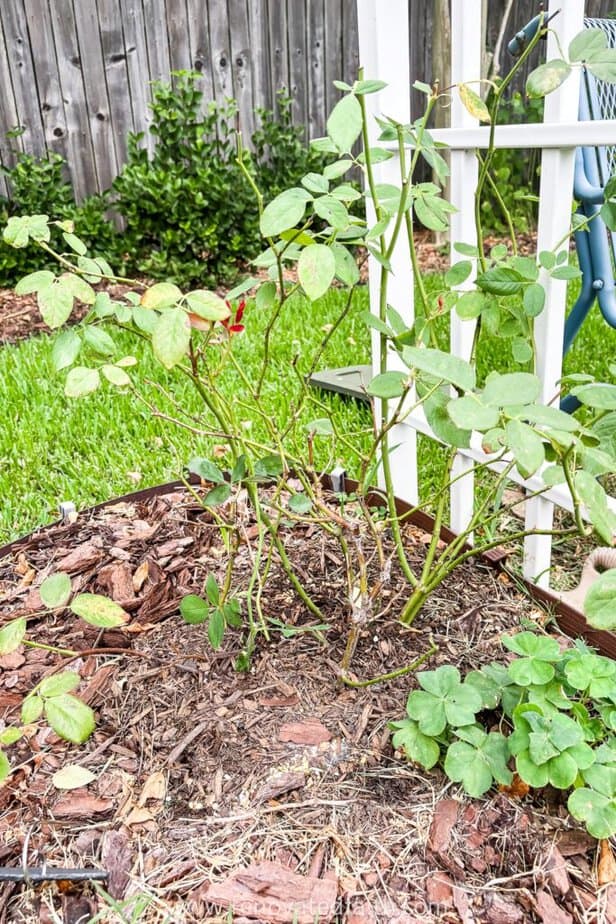
This Lady Heirloom rose is struggling because she gets mostly western sun, so I’m going to create a small pillowcase tent to protect her sunburned canes (below).
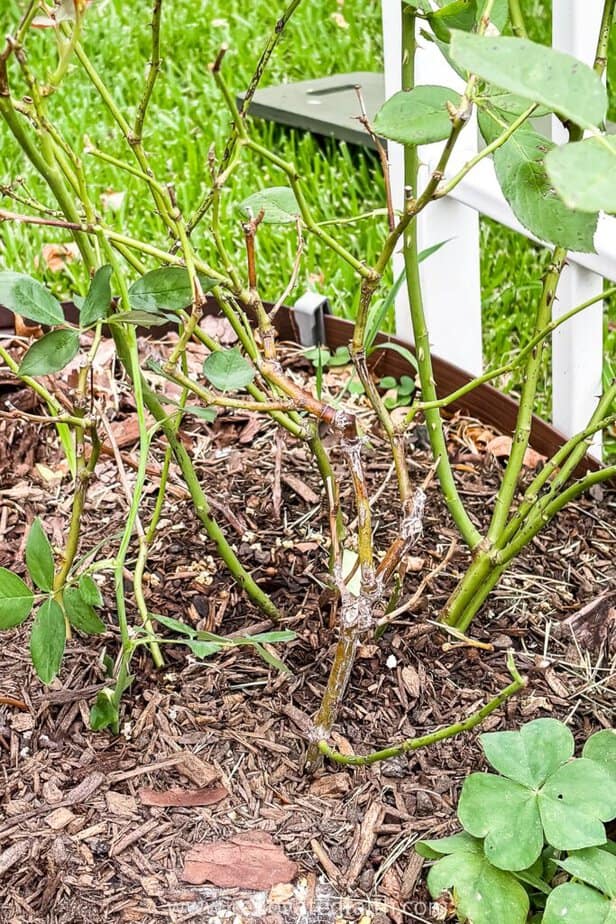
To do this, I use an old pillow case and two garden stakes. I put the pillow case on both stakes and lean it so the plant gets morning sun but some shade from midday and afternoon sun.
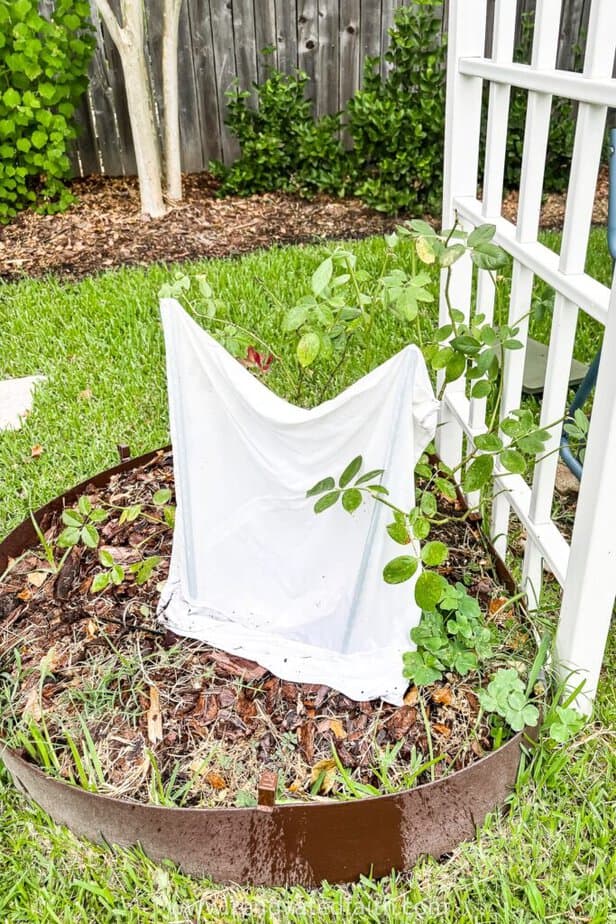
Notice that the top leaves are still getting sun but the canes are protected now. When it gets older and more established, this shouldn’t be an issue.
This has really helped young roses, struggling roses or roses with sunburn on their canes to get through the oppressive heat of the summer months.
Also, when the sprinklers get it wet, it provides some extra humidity.
Tip 10: Manage your Expectations in Summer
Don’t try to force roses to bloom during the hot summer months. Let them do what they need to do to so they can thrive in the fall. Expect flowers to be smaller, less fragrant and faded from the sun. (I recommend cutting rose flowers for bring in during the morning hours, because in the afternoon many blooms will be crispy.)
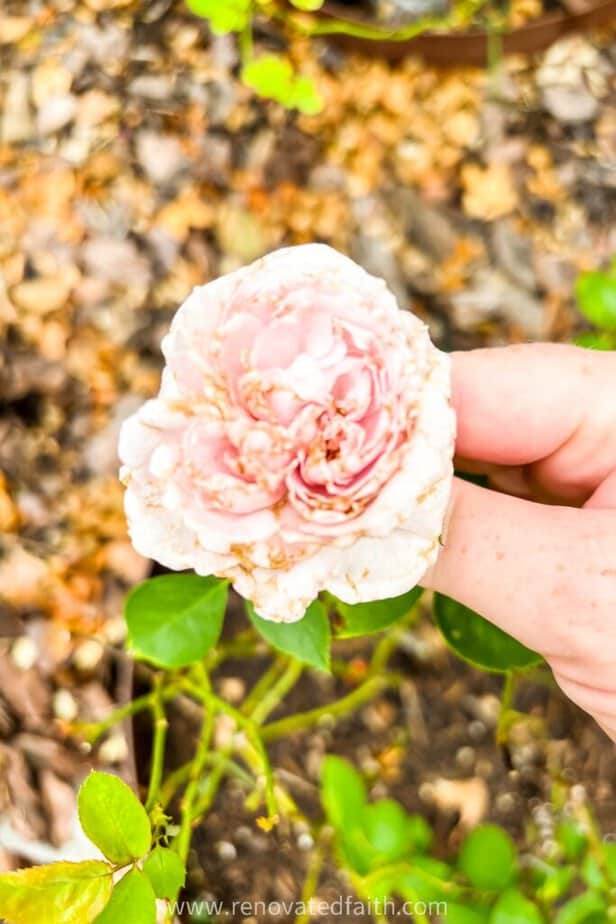
Also, many bushes may drop leaves or you may have some cane dieback. That’s completely ok and before you know it, they will come back in full force when the temperatures are more tolerable in the fall.
Tip 11: Buy Heat-Tolerant Roses
My favorite list of heat tolerant roses is the Star list of roses that you can find here: Star Roses
Any rose from Antique Rose Emporium will be heat-tolerant, as they are grown here in Texas, and you can also research what others have said about heat tolerance for a specific variety by going to HelpMeFind.com.
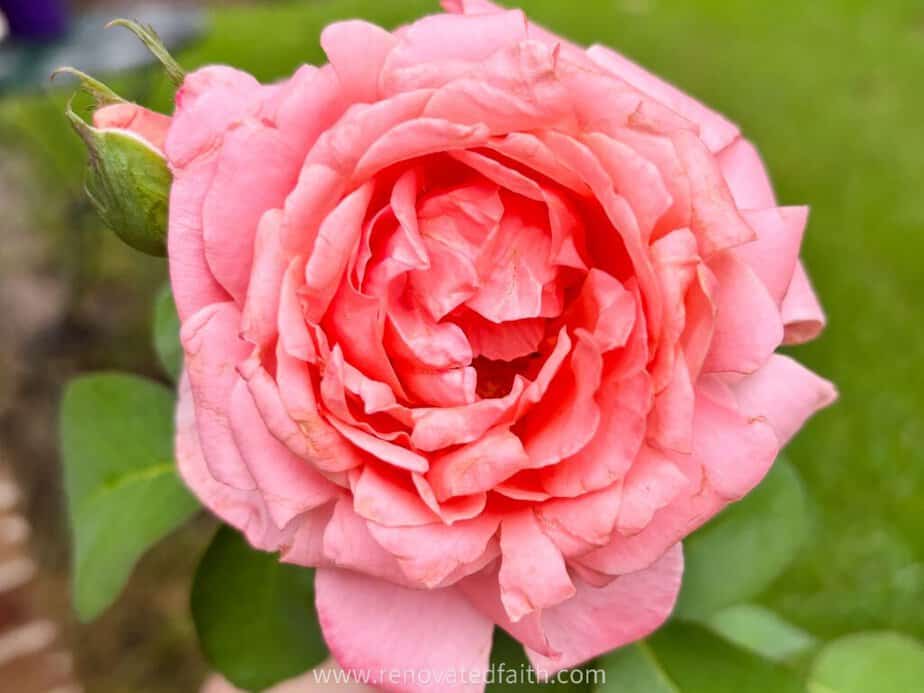
Tip 12: When a Rose Doesn’t Make It…
If you lose a rose during the summer, it’s ok! It happens to the best of us for various reasons. It’s just a part of rose growing.
Experience is our greatest teacher and know that you now have a new spot for a rose variety that you might enjoy even more than the old one!
RENOVATE YOUR FAITH: Taste and See That The Lord is Good
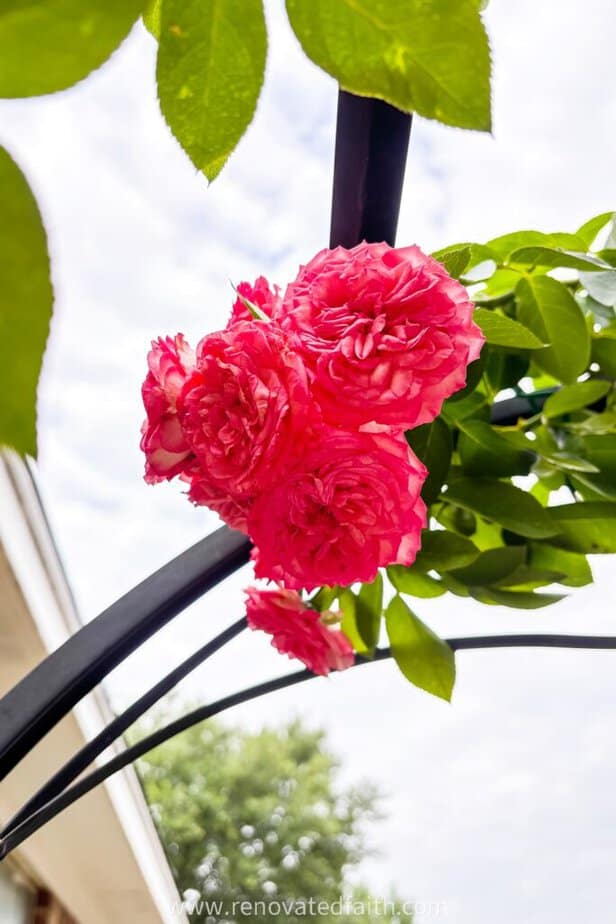
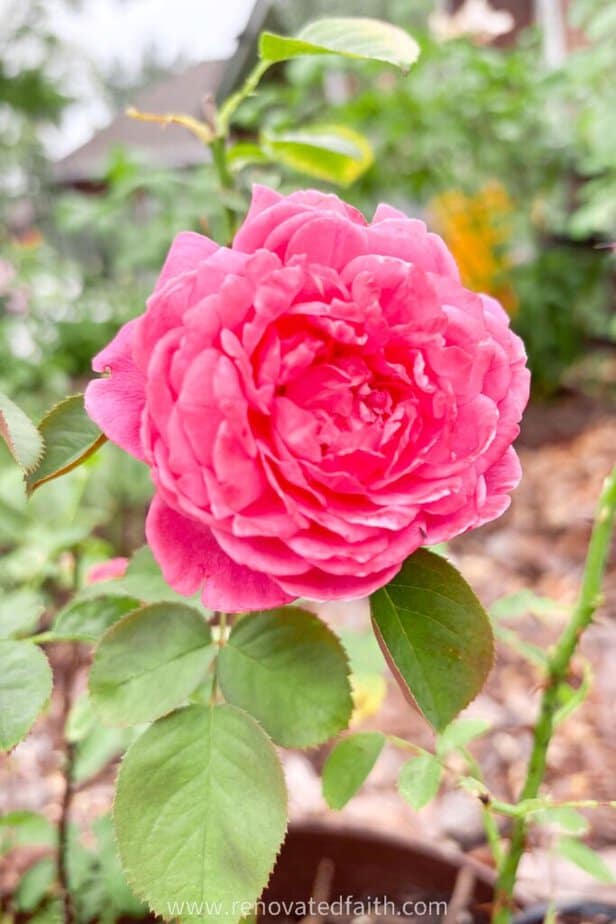
Roses astound me with their dramatic blooms and array of petals. Each bloom is an individual work of art, but I think what I appreciate most of all is their fragrance.
Every morning I get up and walk around my rose garden. As I bury my nose in a rose bloom, I’m in awe of their sweet scent, and the same words come to mind, “Taste and see that the Lord is good!”
Puzzled with why a verse about ‘taste’ would come to mind while smelling a rose, I finally studied the verse:
“Taste and see that the Lord is good. Blessed is the man who finds refuge in Him.” Psalm 34:8
Perhaps the verse mentions taste because, when we taste something, we take it in and it becomes part of us. Our composition is forever changed by tasting something new.
I believe God wants to have the same interaction with us. When we experience Him and taste His goodness, we are left changed. In that sense, the verse gives us an invitation – to taste, and also a promise that what we will taste is, in fact, good.
The more we taste and experience what the One True God has to offer, the more we will know that He is good and He wants good for us.
But we don’t have to come to Him with the perfection of a rose. On the contrary, He is happy for us to take refuge in Him, just as we are.
Every time we taste His goodness by praying to Him or interacting with His Word, we can be sure that we will come away changed and with a greater sense of the goodness that only He can offer.
Most of my projects include a corresponding devotional. For more spiritual encouragement, click here for the rest of my project posts that also include Renovate Your Faith devotionals.
More Posts Related to Caring for Roses in Summer
7 Top Metal Garden Trellis Ideas for Garden Plants & Roses (Budget Finds!)
How to Set Up Drip Irrigation for Roses and Landscape Plants
How to Create a Mounded Flowerbed without Digging
Gaye Hammond’s Not-So-Secret Fertilizer Mix Recipe
Plastic Stepping Stones That Look Like the Real Thing
Final Thoughts on How to Care for roses in Summer
Summer rose care doesn’t have to be complicated or overwhelming. By watering deeply but not too often, mulching well, keeping the pH in check with a little cracked corn, and giving your roses some grace during the hottest stretches, you’ll set them up to bounce back beautifully once the temperatures cool down. Remember that it’s completely normal for roses to slow down, drop a few leaves, or even struggle a bit in extreme heat — that’s just part of living in a hot climate. Be patient with your garden (and yourself!), and before you know it, fall will bring a fresh flush of blooms to enjoy. Happy gardening, friends!
I love to hear your thoughts and questions! Scroll down to leave a comment and I WILL reply! ❤️
Blessings,

Be sure to follow the fun here!
Email Subscription | Instagram | Pinterest | Facebook | Twitter


Karin Peters is a DIY expert and the creator of Renovated Faith. She is a furniture painter, a home design consultant, and a tenacious problem solver determined to help you transform your house into a home. With 17 years of experience with DIY home improvement, she researches and analyses professional processes to adapt them to be easy and cost-effective for DIYers. She then tests every project and product before it appears on the site in a detailed, step-by-step format. After attending Texas A&M University, she received her Master of Divinity with Biblical Languages at Southwestern Baptist Theology Seminary. Her passions unite in Renovated Faith, which shows readers how to create a home that serves them so they can pursue their God-given purposes. About Renovated Faith | Editorial Policy | Facebook | Twitter | LinkedIn
One Comment